All templates
SaaS

CryptoLens — Next.js Crypto Portfolio Analytics Template

Premium dark-mode Next.js crypto portfolio dashboard template with real-time PnL analytics, multi-wallet tracking, and Tailwind v4 + shadcn/ui.
Secure checkout via Gumroad
CryptoLens — Next.js Crypto Portfolio Analytics Template preview

Overview

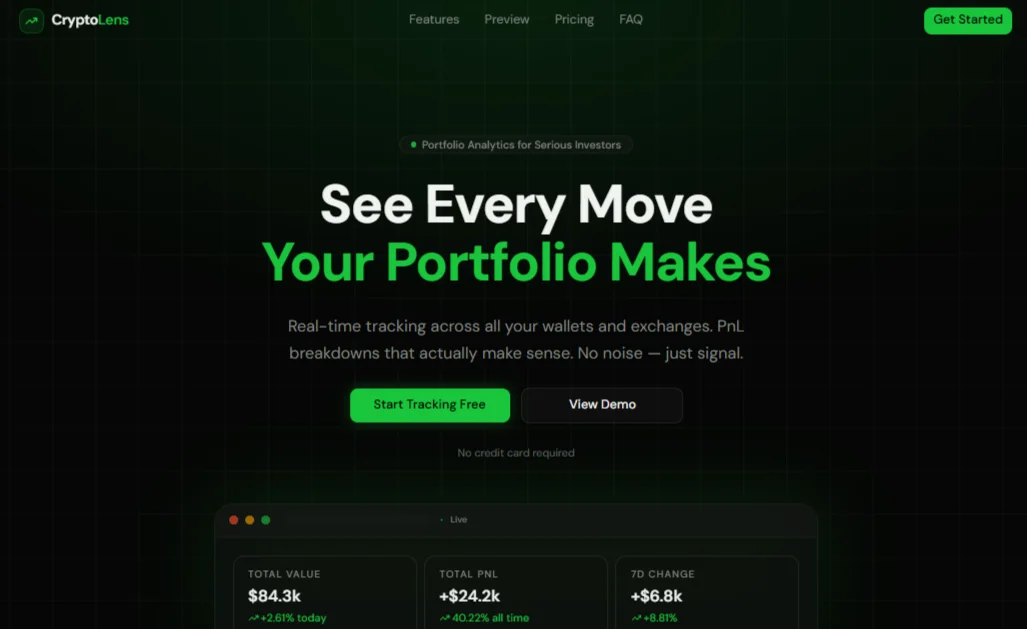
CryptoLens is a premium, dark-mode-only Next.js template built for crypto portfolio trackers, fintech dashboards, and Web3 analytics products. It combines a high-converting marketing landing page with a fully designed internal application covering portfolio overview, PnL analytics, asset watchlists, and multi-wallet management — everything a crypto SaaS founder needs to launch fast without starting from a blank canvas. Built on Next.js App Router, Tailwind CSS v4, and shadcn/ui, the template follows modern conventions for performance, accessibility, and maintainability, making it equally suitable for an MVP or a production-grade fintech product.

The design language centers on a neon-green primary accent set against a near-black oklch background, evoking the profit-driven aesthetic of trading terminals and on-chain analytics tools, while violet and amber accents handle secondary highlights and loss states respectively. Every chart, table, and card is powered by real (demo) data structures that mirror what a production crypto API would return — portfolio value, realized and unrealized PnL, asset allocation, wallet balances, and transaction history — so wiring up your own backend or third-party data provider (CoinGecko, Zerion, Covalent, exchange APIs) is mostly a matter of swapping data sources, not rebuilding UI. Animations powered by Motion add polish to page transitions, counters, and interactive elements without sacrificing performance.

CryptoLens ships with reusable design tokens for gradients and glow effects, a centralized configuration file for all content and SEO metadata, and a component library built almost entirely from shadcn/ui primitives (Accordion, Tabs, Dialog, Table, Select, Switch, Avatar, and more), ensuring consistency and easy long-term maintenance. Whether you're building a crypto portfolio tracker, a DeFi analytics dashboard, an exchange companion app, or a fintech SaaS with a similar data-dense UI, this template gives you a production-ready foundation with best-in-class developer experience.


Stack

  • Framework: Next.js (App Router)
  • Language: TypeScript
  • Styling: Tailwind CSS v4 (oklch color system, dark mode only)
  • UI Components: shadcn/ui
  • Animation: Motion (motion/react)
  • Icons: lucide-react
  • Charts: Recharts (Area, Bar, Pie/Donut)

Project Structure

.
├── app/
│   ├── layout.tsx                 # Global layout — imports baseMetadata & globals.css
│   ├── page.tsx                   # Landing page (composes all marketing sections)
│   ├── globals.css                # Theme tokens, oklch palette, gradients, glows
│   │
│   ├── dashboard/
│   │   └── page.tsx               # Portfolio overview: stats, PnL chart, assets table
│   ├── portfolio/
│   │   └── page.tsx               # Full holdings table, allocation donut, search/sort
│   ├── pnl/
│   │   └── page.tsx               # PnL analytics by period, realized vs unrealized
│   ├── watchlist/
│   │   └── page.tsx               # Market watchlist, price alerts, sparklines
│   ├── wallets/
│   │   └── page.tsx               # Per-wallet balances, tx history, distribution
│   └── settings/
│       └── page.tsx               # Account, notifications, exchange API keys, security
│
├── components/
│   ├── landing/
│   │   ├── Navbar.tsx
│   │   ├── Hero.tsx
│   │   ├── Stats.tsx
│   │   ├── Features.tsx
│   │   ├── Pricing.tsx
│   │   ├── Testimonials.tsx
│   │   ├── FAQ.tsx
│   │   ├── CTAFinal.tsx
│   │   └── Footer.tsx
│   ├── dashboard/
│   │   └── Sidebar.tsx             # DashboardShell — sidebar + mobile nav for app pages
│   └── ui/                         # shadcn/ui components (button, card, table, etc.)
│
├── lib/
│   ├── config.tsx                  # All site content, nav, demo data, SEO copy
│   └── metadata.tsx                # baseMetadata + generateMetadata() + per-page exports
│
└── public/
    └── (icons, og image, favicons)

Quick Start

  1. Install dependencies

    npm install
    
  2. Run the development server

    npm run dev
    

    Open http://localhost:3000 to view the landing page. Internal app pages are available at /dashboard, /portfolio, /pnl, /watchlist, /wallets, and /settings.

  3. Wrap internal pages with the dashboard shell

    Each page under /dashboard, /portfolio, etc. should be rendered inside DashboardShell (from components/dashboard/Sidebar.tsx) to get the sidebar navigation and mobile topbar:

    import { DashboardShell } from "@/components/dashboard/Sidebar";
    
    export default function Layout({ children }: { children: React.ReactNode }) {
      return <DashboardShell>{children}</DashboardShell>;
    }
    

    This is best placed in a nested app/(app)/layout.tsx route group wrapping all internal pages.

  4. Build for production

    npm run build
    npm start
    

Customization

1. Content & copy

Every piece of text in the template — hero headline, features, pricing plans, FAQ, footer links, navigation — lives in lib/config.tsx. Update the exported objects (heroContent, featuresContent, pricingContent, etc.) to rewrite the landing page without touching component code.

2. Demo data

Portfolio stats, asset holdings, PnL history, watchlist items, and wallet balances are also defined in lib/config.tsx (demoPortfolioStats, demoAssets, demoPnLChart, demoWatchlist, demoWallets). Replace these with data fetched from your API, a crypto data provider, or exchange integrations — the component props and data shapes are designed to map directly onto typical crypto API responses.

3. Color palette & theme

All colors are defined as oklch CSS variables in app/globals.css. To change the accent color (currently neon green), update --primary, --ring, --chart-1, and --sidebar-primary. Reusable gradients and glow effects are also defined as CSS variables (--background-image-gradient-hero, --shadow-glow-primary, etc.) — update these once and the effect propagates across every section that references them.

4. Navigation

  • Landing page nav links: navLinks in lib/config.tsx
  • Internal app sidebar links: appNav in lib/config.tsx (each entry includes a lucide-react icon)

5. Components

All UI primitives come from shadcn/ui (components/ui/). To adjust global component styling (radius, spacing, variants), edit the relevant component file directly or update the --radius token in globals.css, which cascades to --radius-sm through --radius-4xl.


SEO Setup

  1. Update siteConfig in lib/config.tsx:

    • name, tagline, description, url, ogImage, keywords, twitter, authors
  2. Per-page metadata lives in pagesMetadata (also in lib/config.tsx). Each entry defines a title and description for one route.

  3. Apply metadata in each page using the helper exports from lib/metadata.tsx:

    export { dashboardMetadata as metadata } from "@/lib/metadata";
    

    Or generate custom metadata for a new route:

    import { generateMetadata } from "@/lib/metadata";
    
    export const metadata = generateMetadata({
      page: "dashboard",
      path: "/dashboard",
    });
    
  4. Global metadata (Open Graph, Twitter cards, robots, icons, manifest) is exported as baseMetadata from lib/metadata.tsx — import and spread it in your root app/layout.tsx.

  5. Replace placeholder assets: add your own favicon.ico, icon.svg, apple-touch-icon.png, and Open Graph image (og.png, 1200×630) to the public/ directory, matching the paths referenced in baseMetadata.

  6. Canonical URLs: update siteConfig.url to your production domain — all canonical URLs and Open Graph URLs derive from this value.


Final Notes

  • This template is dark-mode only by design — there is no light theme toggle, keeping the visual identity consistent with fintech and trading platforms.
  • No inline style={} is used for theming; all colors, gradients, and glows are driven by CSS variables in globals.css, making global restyles fast and consistent.
  • All demo data is illustrative. Before going to production, connect a real data source (CoinGecko, exchange APIs, on-chain indexers, or your own backend) and replace the demo* exports in lib/config.tsx.
  • Components are built to be responsive from mobile to desktop out of the box — test breakpoints (sm, md, lg, xl) when customizing table columns or grid layouts, as several elements progressively hide/show columns at each breakpoint.
  • For support, customization requests, or licensing questions, refer to the FormaUI template page linked above.

Tech stack

NextjsTailwindShadcnMotionRecharts

Tags

nextjstailwindportfoliofintechsaascryptodashboard

Highlights

Full Next.js 15 source codeAll sections as isolated componentsglobals.css design systemconfig.tsx for easy content editingSEO: metadata, Open Graph, JSON-LDSitemap & robots.txtLifetime updates via GumroadMIT license
$49USD
Secure checkout via Gumroad
Get template